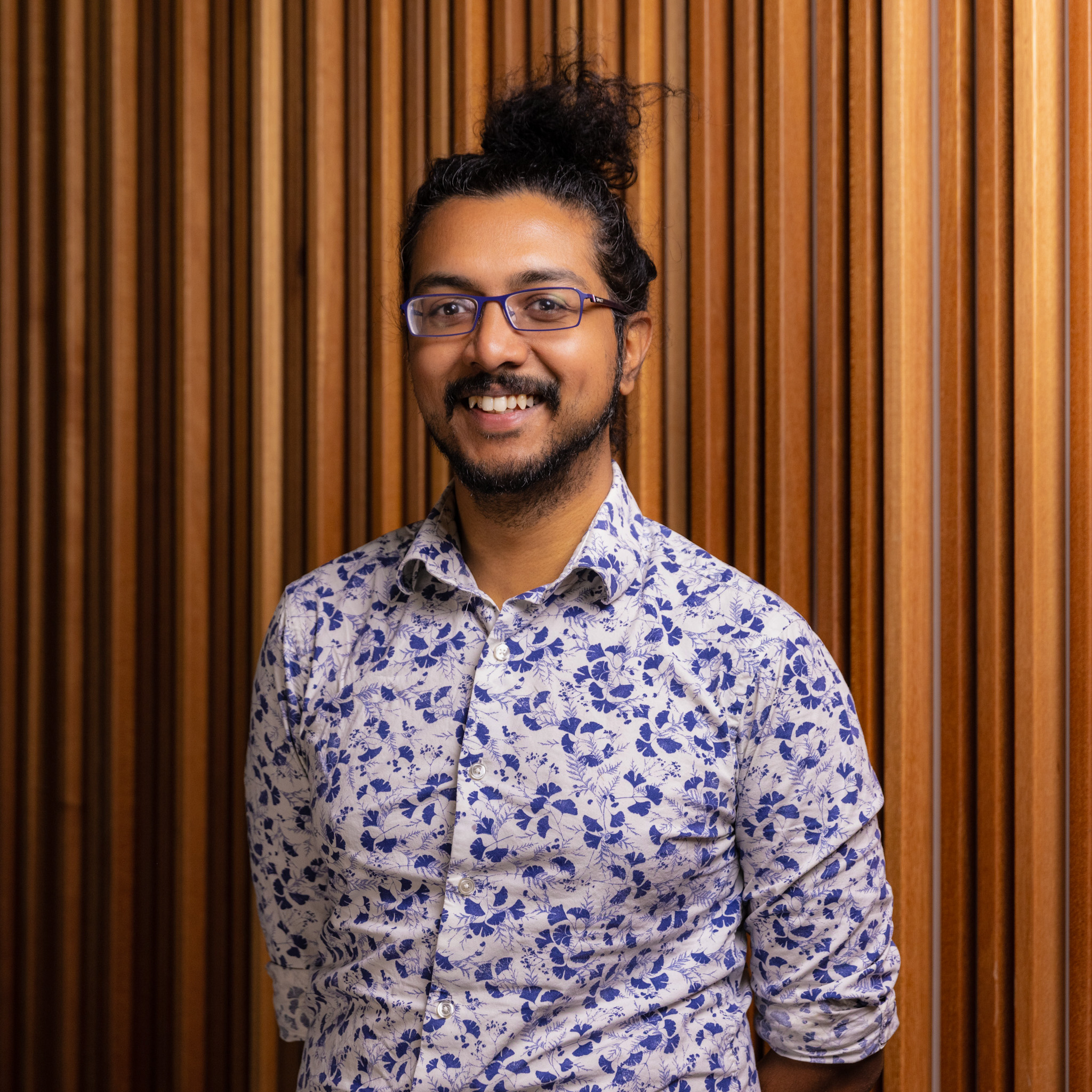
About
My research goal is to give people back agency. Epilepsy and Parkinson's disease take it
away: seizures and epileptic spikes interrupt a life without warning, and altered rhythms
in deep brain structures erode motor control. Getting that agency back means tracking the
dynamics the brain is governed by accurately enough to move them, and to move them
somewhere better. I am an Assistant Professor of Statistical Learning in the Department of
Advanced Computing Sciences at Maastricht University, where I build the statistical and
signal-processing tools that make this possible.
Tracking rhythms in real time. I introduced a state-space approach to
real-time phase estimation (eLife, 2021). It treats each brain rhythm as a latent
state with per-sample uncertainty, instead of something to filter out of the signal.
Independent groups have since adopted it, benchmarked against it or extended it. I then
showed that phase is not uniquely defined for real signals, so closed-loop use needs
uncertainty estimates (eNeuro, 2023). I am now extending this into a general
framework, the State-Space Model of Rhythms. Its first extension detects beta bursts in
Parkinson's disease sample by sample (IEEE EMBC 2026, oral presentation).
Resolving how rhythms drive one another. I develop methods that infer
brain networks: a connectome-constrained graphical lasso for MEG, and a generative
structure–function model of stroke damage. With my students I extended this to sparse
event data. Group-lasso point-process models infer directed epileptic spike networks to
help localise where seizures start (EUSIPCO 2026).
Methods that change what others can measure. Analytic tools I contributed
helped establish low-frequency oscillations as a biomarker of injury and recovery after
stroke (Stroke, 2020), my most-cited work. I showed that thalamic epileptic spikes
disrupt sleep spindles (Brain, 2024). I also showed that a cascade of sleep rhythms
supporting motor memory is hijacked by epileptic spikes (PNAS, 2026). This work was
recognised with the American Epilepsy Society Young Investigator Award (2024), an AES
Fellowship (2023) and an Epilepsy Foundation New England Blue Skies award as co-PI (2023).
Teaching and mentoring. I coordinate quantitative courses across three
bachelor's programmes (Data Science & AI, Computer Science, Brain Science). I bring
students in as collaborators rather than assistants. They have first-authored work at
EUSIPCO, BNAIC and FENS, several came back to do their master's theses with me.
Open science. I treat released code as part of the result, because a
real-time method nobody can inspect cannot be trusted. I publish open access wherever I
can, and I write for a general audience about technology and society, including a piece in
The Hindu
on what we lose with "giant AI".
Before Maastricht, I was a postdoctoral researcher at Boston University and at
Massachusetts General Hospital / Harvard Medical School, after a PhD at UC Irvine with
Ramesh Srinivasan.